Local and State Taxes for the Self-Publishing Author
Federal and state income taxes are the taxes most authors think about — and they're covered in the companion article Federal Taxes for the Self-Publishing Author. But there's another layer that often gets overlooked: local and county business taxes. These are separate from income taxes, separate from your state LLC fees, and required in most jurisdictions regardless of how your LLC is organized or taxed.
Let's start with the one most authors don't know about until they're already operating without it.
County Business Tax — What It Is and Why It Applies to You
Depending on what state your LLC is registered in, a County Business Tax Number may be required if you are engaging in a business, profession, or occupation located within that county. Anyone providing merchandise or services to the public within the county's jurisdiction — including a single-person company or a home-based occupation — must obtain a county business tax account to operate.
This is in addition to any other taxes or fees paid to operate your business, including your state LLC fees and your state income tax. Some states refer to this as an occupational license — but let's be direct: this is a tax.
⚠ The tax year your county recognizes may differ from your business's tax year. In Florida, for instance, the county business tax year runs October 1 through September 30, and annual tax bills are sent in August — not aligned with the standard January–December federal tax year. Know your county's specific tax calendar so you're not caught off guard by a bill on a different schedule than you expected.
Business Tax Receipts
When paid, a Business Tax Receipt (BTR) is issued. Most counties are quick to protect themselves with a disclaimer along these lines:
"The Business Tax Receipt does not guarantee the quality of the work or regulate the business. The receipt also does not permit a person or business to violate any existing regulatory or zoning laws of the state, county, or cities, nor does it exempt the business from licenses or permits that may be required by law."
Some states go further and explain what the tax is used for, but most simply require it and impose stiff penalties for businesses operating without one. A typical penalty structure looks like this:
"Operating without having paid the business tax is a misdemeanor punishable by a $100 minimum fine plus a daily fine of 25% of the total annual tax due. The total fine may not exceed five times the value of the tax or $500, whichever is greater. For businesses already registered to pay the tax, late payment must include a delinquency penalty of up to 25% per tax year."
The fee itself varies based on the type of business you operate and how many employees you have.
Sample Fee Schedule
Here is a sample county fee schedule, representative of what you'll find in many jurisdictions. Fees are shown for a full year (Oct 1 – Sept 30) and a half year (Apr 1 – Sept 30):
|
Field / Spec |
Value / Requirement |
Notes |
|
Advertising Space Renters |
$3.15 / $1.58 |
Per unit |
|
Amusement/Recreational |
$15.75 / $7.88 |
|
|
Attorney |
$25.00 / $12.50 |
|
|
Blanket Promoter |
$525.00 / $262.50 |
|
|
Circus/Traveling Show |
$236.25 (per day) |
Same rate for full or half year |
|
Contractor (1-10 employees) |
$11.81 / $5.90 |
Scales with employee count |
|
Dance/Entertainment |
$236.25 / $118.12 |
|
|
Finance/Lending/Investment |
$78.75 / $39.38 |
|
|
Fortune Teller/Reader/Etc. |
$236.25 / $118.12 |
|
|
Manufacturing (1-10 employees) |
$19.68 / $9.84 |
Scales with employee count |
|
Pawn Broker |
$354.37 / $177.18 |
|
|
Professional |
$31.50 / $15.75 |
← This is your category |
|
Service/Retail (1-5 employees) |
$14.43 / $7.22 |
Scales with employee count |
|
Theater |
$393.75 / $196.88 |
Based on population |
|
Wholesale/Trading/Brokering |
$31.50 / $15.75 |
|
For the purposes of your publishing company, select "Professional" — and be glad you're not a circus performer or fortune teller. At $31.50 per year for a full-year registration, this is one of the least expensive ongoing compliance requirements your LLC will have.
How to File
The process for filing your county business tax varies by jurisdiction but is generally straightforward:
Visit your county clerk's website or office to obtain the application form. Some counties allow online filing; others require an in-person visit.
Complete the form with your LLC's name, address, EIN, the type of business (Professional), and any other information the county requires.
Pay the applicable fee. For a single-member publishing LLC with no employees, this is typically the flat Professional rate — around $31.50 per year in many counties.
A County Business Tax Receipt is issued upon payment. Keep it with your other business documents.
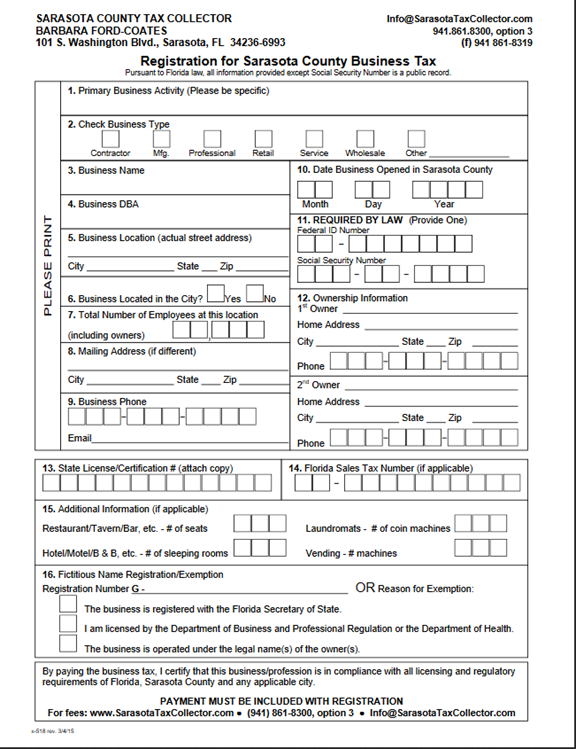
Once you've filed the completed form and paid the fee, you'll be given a certificate that displays your county tax ID number. Some states require you to display this in your place of business — since you're likely working from home, that requirement is a bit academic. Filing it with the rest of your business documents is sufficient. (This author may have hung theirs in the bathroom. It's a valid choice.)
Home-Based Business Considerations
A common question: do I need a county business tax receipt if I work from home? Yes — the requirement applies to any business operating within the county's jurisdiction, including home-based businesses. In fact, some jurisdictions have additional home-based business permit requirements beyond the business tax receipt itself. Check with your county clerk to confirm what applies to your specific situation.
The important thing to understand is that operating without a business tax receipt — even from a home office, even as a one-person operation — exposes you to the penalties described above. The fee is small enough that there's no reason to risk it.
Renewal
Most counties require annual renewal of your business tax receipt. Whoever is managing the LLC's business affairs — covered in LLC Management for the Indie Author — should have this renewal date on the calendar, along with your state Annual Report deadline (covered in LLC Filing Fees) and your DBA renewal if applicable.
All county business tax fees are tax deductible as ordinary and necessary business expenses. Keep your receipt of payment with your other business expense records for your accountant.
The Bigger Picture: Layered Compliance
County business taxes are one layer of an increasingly complex local compliance picture that many small business owners — and most indie authors — aren't fully aware of until something goes wrong. The layers, roughly in order of scope:
|
Field / Spec |
Value / Requirement |
Notes |
|
Federal |
IRS income tax, quarterly estimated payments, self-employment tax |
Schedule C, SE — covered in Federal Taxes for the Self-Publishing Author |
|
State |
State income tax, franchise tax, annual LLC fee |
Covered in LLC Filing Fees and Federal Taxes |
|
County |
Business tax receipt / occupational license |
This article |
|
City/Municipality |
Local business license (some jurisdictions) |
Check with your city clerk |
Not every layer applies to every author — state income tax doesn't apply in the nine no-income-tax states, and some cities don't impose local business licenses. But each layer requires its own research, its own filing, and its own calendar reminder. The common mistake is to handle the federal and state layers correctly and assume that's everything, when the county and city layers are still outstanding.
Conclusion
The county business tax is one of the smallest fees and simplest filings in your LLC's compliance picture — but it's also one of the most commonly overlooked. The consequences of operating without one range from fines to misdemeanor charges, which is a disproportionately large problem for what costs roughly $30 per year to avoid.
File it the same week you open your business bank account. Add the renewal date to your compliance calendar alongside your state Annual Report deadline. Keep the receipt with your business documents.
The paperwork required to run a legitimate publishing LLC is substantial — but each piece, taken individually, is manageable. The county business tax receipt is one of the smallest pieces, with one of the steepest penalty structures for skipping it. Don't skip it.
- Randall